
Reference Electrodes: Types, Design, and Practical Limitations
1. General Requirements for a Reference Electrode
A reference electrode (RE) is only useful if its potential is effectively independent of everything happening at the working electrode. This translates into a short list of hard requirements:
- Non-polarizability. The RE reaction must be fast and reversible enough that the small currents drawn during a measurement (ideally near-zero for potentiometry, but not always zero in three-electrode setups) do not shift its potential. This is why REs are built as electrodes of the first or second kind with a large exchange current density, not as arbitrary redox couples.
- Reproducibility. Two electrodes of the same type, built independently, should agree to within a few tenths of a millivolt. This is what makes tabulated potentials (vs. SHE) meaningful at all.
- Stability over time. No slow side reactions, no depletion of the active phase, no drift from contamination of the internal filling.
- Low and well-characterized temperature coefficient. Every RE has some dE/dT; what matters is that it is small, known, and reproducible so it can be corrected for.
- Chemical robustness / inertness toward the test solution, mediated through a junction that allows ionic contact but minimal chemical crosstalk. The junction (liquid, gel, ceramic, capillary) is usually the weakest link of the whole assembly, not the electrode reaction itself.
- A well-defined potential on an absolute scale (vs. SHE), so that results from different labs, instruments, and electrode types can be converted and compared.
- Practicality: mechanical robustness, reasonable shelf life, safe and legal to store/dispose of, tolerant of the storage conditions actually available in a working lab (see the companion handout on nighttime KCl precipitation for a concrete example of how “practicality” and “thermodynamics” pull against each other).
Every RE design discussed below is a different compromise among these criteria — nothing on this list is free.
2. The Hydrogen Electrode: the Absolute Standard, and Why It Is Rarely Used Directly
2.1 SHE / NHE
The standard hydrogen electrode is defined by convention as E° = 0 V at all temperatures, for H⁺ at unit activity in equilibrium with H₂ gas at unit fugacity (≈1 atm/1 bar) on platinized platinum:
Advantages:
- The only reference whose potential is defined, not measured — every other electrode’s tabulated value is ultimately anchored to it.
- Thermodynamically ideal: fast kinetics on platinized Pt, genuinely reversible, in principle usable at any pH if H⁺ activity and H₂ fugacity are known.
Disadvantages — and they are severe enough that almost nobody uses a “classical” SHE in routine work:
- Requires a continuous, pressure-regulated supply of high-purity H₂ gas bubbled over platinized Pt — a genuine safety and logistics burden in most labs (gas cylinders, regulators, venting).
- Catalyst poisoning: platinized Pt is extremely sensitive to trace sulfur compounds, CO, arsenic compounds, and heavy metals (including mercury) — a single contaminated solution can permanently deactivate the electrode.
- Extremely sensitive to the exact activity of H⁺ (not concentration) and to the exact H₂ pressure — both must be known/controlled precisely, which is difficult outside a metrology lab.
- Fragile, awkward to transport, effectively unusable in the field or for routine bench electrochemistry.
- Only rigorously valid in aqueous, relatively clean solutions; unusable as-is in non-aqueous media, in the presence of strong oxidants, or in biological/organic matrices.
Because of this, the SHE survives mainly as a conceptual anchor and calibration reference, not a day-to-day working electrode. Two classes of “practical hydrogen electrodes” have been engineered to keep the thermodynamic advantages while removing most of the logistical burden.
2.2 Engineering Solutions: Practical Hydrogen/RHE Electrodes
Reversible Hydrogen Electrode (RHE), general concept. Unlike the SHE, an RHE is immersed directly in the test electrolyte at its actual (arbitrary) pH, with H₂ in equilibrium with that same solution. Its potential then tracks the local pH by the Nernst relation:
This is extremely convenient in electrocatalysis/fuel-cell/electrolyzer work, because overpotentials for H₂ evolution/oxidation collapse onto the same RHE-referenced value regardless of pH — but note that an RHE is not a fixed potential vs. SHE; it is a pH-tracking scale, and results must always be reported explicitly “vs. RHE,” with the pH stated.
ALS RHE Kit (a widely used commercial example). Rather than piping in H₂ from a cylinder, hydrogen is generated in situ by electrolysis of a small volume of acid (e.g., ~0.5 M H₂SO₄) using a small portable hydrogen generator, and stored/trapped in a sealed compartment in contact with a Pt electrode.
- Pros: eliminates the gas cylinder entirely; compact, portable, reasonably fast to set up; good potential stability once generated; works as a genuine RHE (immersed in or salt-bridged to the test solution).
- Cons: requires a double-junction chamber for anything other than strong acid (<pH 2) to avoid contaminating the test solution with the internal acid or vice versa; the trapped H₂ reservoir is finite and must be periodically regenerated; still Pt-catalyst-based, so still vulnerable to poisoning by sulfide, CO, and similar species; not maintenance-free.
Gaskatel HydroFlex (an alternative engineering philosophy). Instead of a gas headspace, HydroFlex uses a Pd–Pt gas-diffusion element fed by a small, replaceable internal hydrogen cartridge (chemically generated hydrogen source), with no internal liquid electrolyte at all.
- Pros: no liquid junction and therefore no diffusion potential and no risk of contaminating the test solution with a foreign electrolyte; essentially maintenance-free (the cartridge is rated for roughly 6–12 months of continuous operation); no mercury or other heavy metals; PTFE/PEEK body tolerates a very wide pH range (down to strongly acidic, up to pH ≈16) and aggressive media, including concentrated fluoride solutions that would attack glass-bodied electrodes.
- Cons: the hydrogen cartridge is a consumable with a finite, fixed lifetime that must be tracked and replaced; as a Pt/Pd surface it is still catalytically poisonable in principle; higher unit cost than a simple Ag/AgCl or calomel electrode; still best practice to periodically check it against a “master” electrode (e.g., calomel or Ag/AgCl) rather than trusting it blindly for years.
Other practical hydrogen-type approaches worth knowing:
- Dynamic Hydrogen Electrode (DHE): H₂ is generated continuously in situ by electrolyzing the test solution itself at a small auxiliary Pt wire/foil, producing a thin layer of adsorbed/evolved H₂ right at the working surface. Simple and cheap, but the potential depends on the (small) polarizing current used to generate the gas and is less rigorously defined than a true RHE.
- Pd–H quasi-reference electrodes: hydrogen is absorbed into the palladium lattice (β-PdH phase) rather than kept as free gas; the Pd–H equilibrium gives a potential close to (but not identical to) the H⁺/H₂ couple, without any gas handling. Convenient and compact, but less accurate and more prone to slow drift as the hydrogen content of the Pd changes with use.
3. Calomel Electrodes (Hg/Hg₂Cl₂/KCl)
3.1 Basic construction and the storage problem
The classical Hg/Hg₂Cl₂ (calomel) electrode pairs a mercury pool coated with a Hg₂Cl₂ (calomel) paste with a KCl solution — saturated (SCE), or 3.5 M / 1 M / 0.1 M in less common variants. Its temperature-dependence issues are qualitatively the same KCl-solubility story discussed for Ag/AgCl electrodes (Section 1 of the “Reference Electrodes at Rest” handout) — but calomel adds two problems of its own on top of that:
- Thermal disproportionation. Above roughly 60 °C, Hg₂Cl₂ tends to disproportionate (2 Hg₂Cl₂ → HgCl₂ + 2 Hg or related pathways), slowly generating dissolved mercuric species in solution. This causes a genuine, sometimes hysteretic drift in potential that does not simply reverse itself when the electrode is cooled back down — the electrode “remembers” having been overheated.
- Photosensitivity and slow aging. Calomel and mercury species are somewhat light-sensitive and interact slowly with dissolved oxygen and trace impurities over months of use, contributing to a slow baseline drift even at room temperature — this is part of why old textbooks recommend rebuilding rather than indefinitely reusing a calomel half-cell.
- Fragility and orientation sensitivity. The mercury/calomel/KCl layering inside the electrode body is easily disturbed by shock, vibration, or inversion, which can physically remix the layers and ruin the potential until the electrode is rebuilt or re-equilibrated.
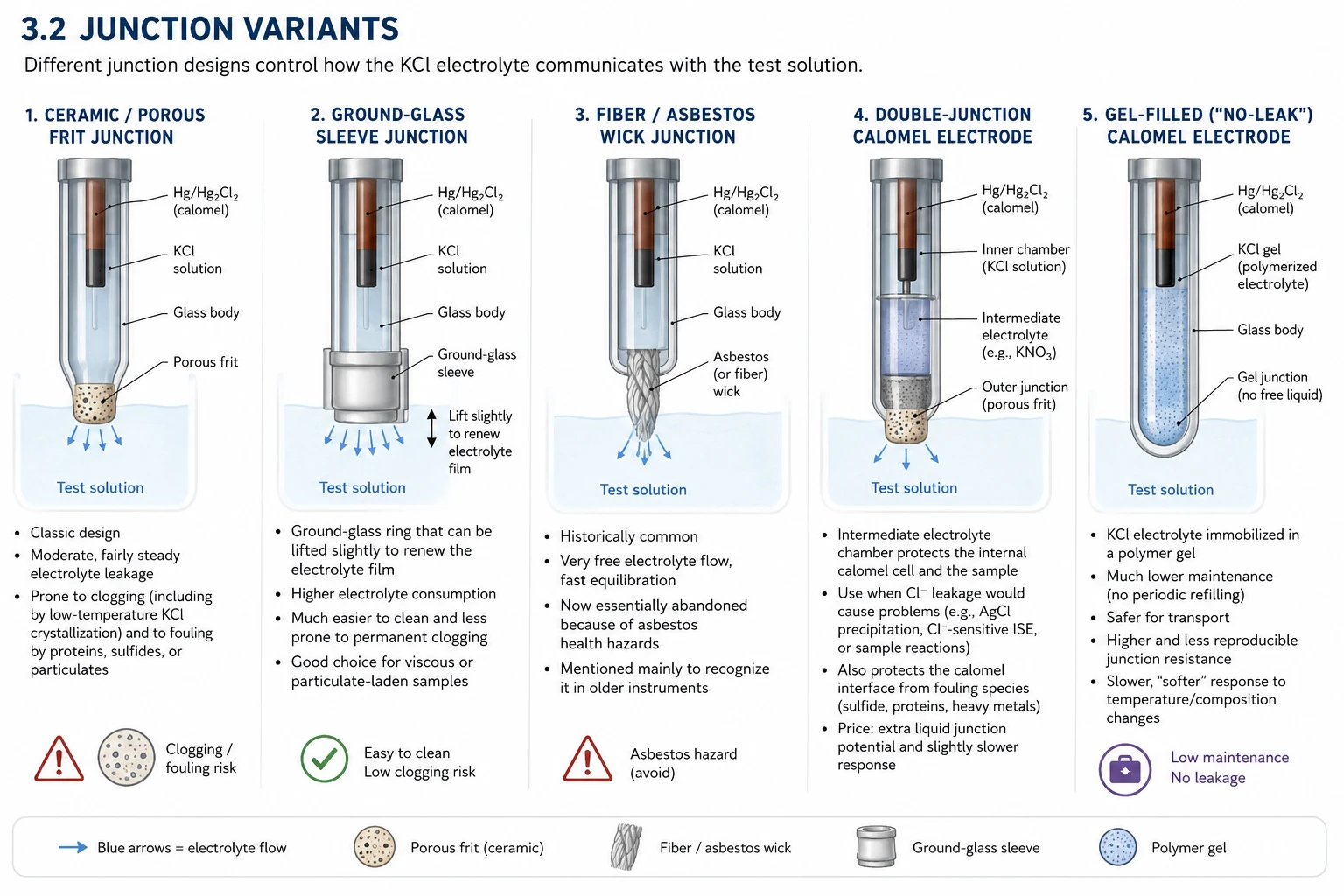
3.2 Junction variants
- Ceramic/porous frit junction — the classic design; moderate, fairly steady electrolyte leakage; prone to clogging (including by the same low-temperature KCl crystallization problem as Ag/AgCl electrodes) and to fouling by proteins, sulfides, or particulates in the test solution.
- Ground-glass sleeve junction — a ground-glass ring that can be lifted slightly to renew the electrolyte film; higher electrolyte consumption but much easier to clean and less prone to permanent clogging; a good choice for viscous or particulate-laden samples.
- Fiber/asbestos wick junctions — historically common (very free electrolyte flow, fast equilibration) but now essentially abandoned in modern equipment because of asbestos health hazards; mentioned here mainly so you recognize it in older instruments.
- Double-junction calomel electrodes — an intermediate electrolyte chamber (often KNO₃ or a chloride-free electrolyte) is placed between the internal Hg/Hg₂Cl₂/KCl half-cell and the test solution. This is used whenever (a) Cl⁻ leaking into the sample would be a problem — e.g., precipitating AgCl, interfering with a Cl⁻-sensitive ISE, or reacting with the sample chemistry — or (b) sample species (sulfide, proteins, heavy metals) would otherwise reach and foul the mercury/calomel interface directly. The price is an extra liquid junction potential and slightly slower response.
- Gel-filled (“no-leak”) calomel electrodes — the KCl electrolyte is immobilized in a polymer gel rather than free liquid. Much lower maintenance (no periodic refilling), safer for transport, but higher and less reproducible junction resistance, and a somewhat slower, “softer” response to temperature/composition changes than a free-flowing junction.
3.3 Mercury toxicity, disposal, and phase-out
This is now the dominant practical concern with calomel electrodes rather than a footnote. Metallic mercury and calomel are classified as hazardous waste in essentially every jurisdiction; they cannot be disposed of down the drain or in ordinary trash, must be logged, stored in sealed unbreakable containers, and picked up by a licensed hazardous-waste contractor. Many institutions (and increasingly many national/regional regulations) have restricted purchase of new mercury-containing lab equipment altogether, and university EHS offices frequently ask departments to actively phase calomel electrodes out in favor of Ag/AgCl. Practical consequences for a working lab:
- New calomel electrodes and replacement mercury/calomel fill kits are harder to source than they once were, and shipping mercury is itself regulated (e.g., restricted under transport-of-dangerous-goods rules).
- A broken calomel electrode is a mercury spill, not routine glass breakage — it requires spill-response procedures, not a broom and dustpan.
- End-of-life electrodes must be tracked and disposed of as mercury waste, with associated cost and paperwork that a Ag/AgCl electrode simply does not generate.
3.4 Lifetime and maintenance
A well-made, well-stored calomel electrode can remain accurate for years, but requires: periodic KCl top-up (free-flowing junctions lose electrolyte over time), inspection for mercury droplet integrity and layer disturbance, avoiding storage below the KCl freezing/precipitation point and above ~50–60 °C, keeping the junction wetted at all times (never allowed to dry out), and periodic comparison against a master/standard electrode to catch slow drift before it corrupts data.
3.5 Summary: pros and cons
| Calomel (SCE and variants) | |
|---|---|
| Pros | Very well characterized historically (huge body of tabulated literature data assumes SCE); inexpensive; genuinely very stable if properly thermostated and not overheated |
| Cons | Contains mercury — toxic, regulated, expensive/difficult to dispose of, increasingly restricted or banned outright in many institutions; thermally unstable above ~50–60 °C with hysteretic drift; photosensitive/slowly aging; fragile internal structure; same KCl-crystallization storage problem as Ag/AgCl, on top of the mercury issues |
4. Silver/Silver Chloride Electrodes (Ag/AgCl/KCl)
This is the electrode discussed in depth in the companion handout on nighttime KCl precipitation (mechanism, Nernst-based ΔE table for saturated/3.5 M/3 M/1 M, and the Horiba 3.33 M design). Here we add the points relevant to a general survey:
- Mercury-free — the main reason Ag/AgCl has displaced calomel as the default reference electrode across almost all modern instrumentation, from benchtop pH meters to corrosion test rigs.
- Wider usable temperature range than calomel — commercial Ag/AgCl electrodes are routinely rated up to 100 °C and beyond (some specialized high-temperature versions well past that), without the sharp thermal-disproportionation ceiling calomel has.
- Junction variants mirror calomel almost exactly: ceramic frit, ground-glass sleeve, gel-filled/“no-leak” (e.g., commercial polymer-plug designs marketed as low-maintenance, drift-free-ish electrodes for small-volume or field cells), and double-junction Ag/AgCl for the same reasons as double-junction calomel — protecting Cl⁻-sensitive samples from chloride contamination, or protecting the electrode itself from samples containing sulfide, bromide, iodide, or proteins.
- A failure mode calomel does not share: halide exchange. If the test solution contains Br⁻, I⁻, or S²⁻, these can slowly convert the AgCl coating (or precipitate inside the junction) to AgBr, AgI, or Ag₂S, shifting the electrode’s effective potential and eventually degrading the junction. This is the single strongest argument for a double-junction Ag/AgCl electrode in biological, sulfide-containing, or halide-rich matrices.
- Silver leaching / Ag⁺ contamination of the sample is possible in principle (analogous to Hg leaching from calomel, though generally regarded as less of an environmental/toxicity concern), which matters for protein-containing or otherwise Ag⁺-sensitive samples.
- Maintenance: same electrolyte refill/inspection routine as calomel, plus the option (not available with calomel) of electrochemically re-chlorinating a worn Ag/AgCl wire to restore the coating rather than discarding the electrode.
- Environmental/regulatory profile: far more favorable than calomel — no special hazardous-waste mercury disposal procedure, no import/export/transport restrictions comparable to mercury, which is itself a major reason for its now near-universal adoption.
5. Other Reference Electrode Solutions
- Mercury/mercurous sulfate electrode (MSE, Hg/Hg₂SO₄/K₂SO₄ or H₂SO₄): used specifically when chloride contamination of the test system is unacceptable (certain corrosion and electroplating baths, systems containing Ag⁺ or Pb²⁺ that would precipitate with Cl⁻). Still mercury-based, so it carries the same toxicity/disposal burden as calomel, without even calomel’s advantage of universal familiarity.
- Mercury/mercuric oxide electrode (Hg/HgO, in KOH electrolyte): the standard reference for strongly alkaline systems (battery research, alkaline fuel cells, some corrosion work in caustic media) where Ag/AgCl and calomel are both poorly suited. Same mercury-handling caveats apply.
- Copper/copper sulfate electrode (CSE, Cu/CuSO₄): the workhorse of field cathodic-protection surveys on buried pipelines and reinforced concrete. Robust, cheap, simple to build and use in rough field conditions, but comparatively imprecise and reproducible only to tens of mV rather than the sub-mV reproducibility expected of a lab-grade reference — adequate for CP criteria, not for precision electrochemistry. Also subject to its own version of the KCl-type problem: CuSO₄ solubility and crystallization behavior in the porous plug under temperature swings in outdoor/buried service.
- Zinc/zinc sulfate or silver/silver sulfate electrodes: occasional specialized field or chloride-free-system alternatives to CSE, with similar practicality-over-precision trade-offs.
- Silver-wire pseudo-reference electrodes: common in non-aqueous electrochemistry (organic solvents, ionic liquids) where none of the aqueous REs above are chemically compatible. A bare Ag or Pt wire has no fixed, universally tabulated potential — it must be calibrated in situ against an internal standard (classically the ferrocene/ferrocenium couple) for every solvent/electrolyte system, every time.
- “Leakless” gel/polymer-plug commercial reference electrodes (e.g., small-format Ag/AgCl or calomel electrodes with an immobilized gel junction instead of a free-flowing one): designed for small-volume electrochemical cells, microelectrode work, and situations where a continuously leaking junction would unacceptably contaminate a small sample volume. Trade the same maintenance-vs-junction-resistance compromise as the gel-filled variants mentioned in Sections 3 and 4.
6. pH Range and Other Limitations, Side by Side
| Electrode | Practical pH range | Key limitations beyond pH |
|---|---|---|
| SHE / classical H₂ electrode | Defined for any pH in principle | Pt poisoning by S, CO, As, Hg species; requires clean aqueous media; gas handling |
| RHE (ALS-type, gas headspace) | Best in strong acid without double junction (<pH 2); wider with double-junction chamber | Same catalyst-poisoning risk as SHE; finite trapped-gas lifetime |
| Gaskatel HydroFlex | pH −2 to 16 (PTFE/PEEK body) | Consumable hydrogen cartridge (6–12 month life); still Pt/Pd-surface, still poisonable in principle |
| Calomel (SCE) | Roughly 0–14, general aqueous use | Mercury toxicity/disposal; unstable >~50–60 °C; freezing/KCl-crystallization at low T; incompatible with strong oxidants, sulfide/protein-rich samples (fouls Hg surface) without double junction |
| Ag/AgCl | Roughly 0–14, widest general-purpose range of the classical REs | Halide exchange (Br⁻/I⁻/S²⁻) degrades AgCl coating and junction; same KCl freezing/crystallization issue at low T as calomel; avoid strongly reducing media that can reduce AgCl to metallic Ag |
| Mercury/mercury sulfate (MSE) | General aqueous, Cl⁻-free systems | Mercury handling/disposal; must avoid Cl⁻ contamination of its own filling solution |
| Mercury/mercuric oxide (Hg/HgO) | Strongly alkaline only | Mercury handling/disposal; unsuitable for neutral/acidic media |
| Copper/copper sulfate (CSE) | Field/soil/concrete CP measurements, not precision lab work | Lower reproducibility (tens of mV); CuSO₄ solubility/crystallization in the plug under field temperature swings |
| Ag-wire pseudo-reference | Non-aqueous / ionic liquid systems only | No fixed potential; must be calibrated in situ every time (e.g., vs. ferrocene) |
A general pattern worth internalizing across the whole table: essentially every classical wet-chemistry reference electrode shares two families of failure mode — a junction problem (clogging, fouling, unwanted chemical exchange with the sample) and a filling-solution phase-stability problem (solubility limits shifting with temperature, whether that solution is KCl, CuSO₄, or K₂SO₄). The engineering solutions surveyed here — double junctions, gel immobilization, mercury-free chemistries, gas-cartridge or Pd-hydride hydrogen sources — are all, in one way or another, ways of pushing one or both of those two failure modes further out of the range you expect to encounter in practice.